



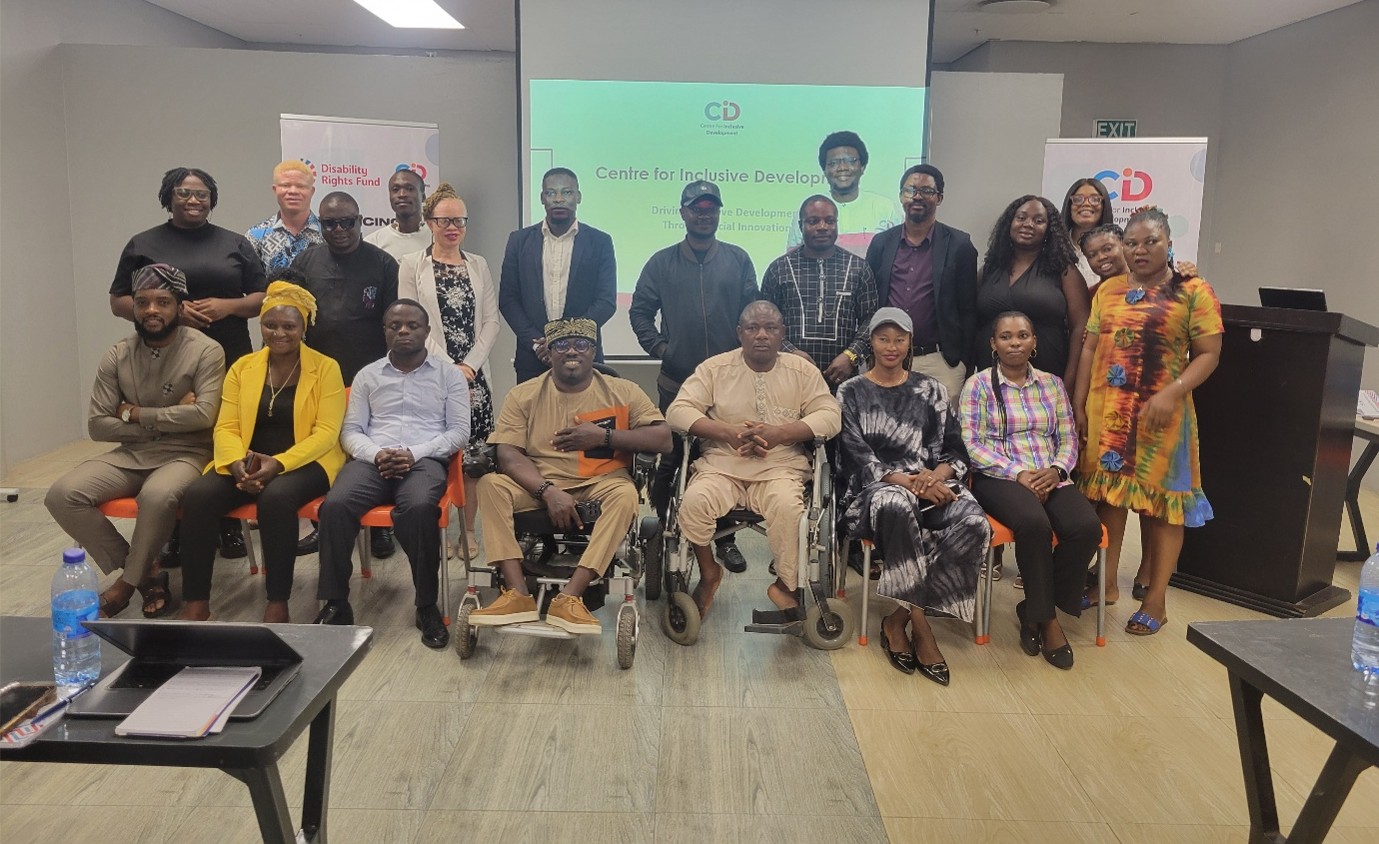
The Center for Inclusive Development, with support from the Disability Rights Fund, has completed a series of digital accessibility trainings under its Enhancing Digital Accessibility for Persons with Disabilities in Nigeria project.
Over three days, April 28-30, 2026, CID engaged representatives from Organizations of Persons with Disabilities (OPD), IT professionals, and technology developers in a workshop on digital accessibility audit, advocacy, and design.
For millions of Nigerians with disabilities, the internet and applications are not the open, equal space often assumed. Websites without text alternatives exclude blind users. Videos without captions and audio without transcripts exclude deaf users. Platforms requiring a mouse exclude persons with motor disabilities. Nigerian banks’ applications and fintech apps are rarely designed with accessibility in mind. E-registration portals, including INEC systems, use language too complex for users with cognitive disabilities. Forms fail to indicate errors clearly. Poor colour contrast and missing image descriptions create further barriers.
These barriers and more cut millions of Nigerians off from public services, economic opportunity, and civic participation, yet they can be fixed with the right knowledge and will to act.
Nigeria’s legal framework provides the foundation. The Discrimination Against Persons with Disabilities (Prohibition) Act of 2018 obligates public and private institutions to ensure accessibility. NITDA has emphasized inclusive infrastructure as part of its Strategic Roadmap and Action Plan (SRAP 2021-2024 & 2.0) to ensure no demographic or region is left behind. The Web Content Accessibility Guidelines (WCAG 2.1) are referenced in government procurement requirements. What has been missing is the capacity to understand, apply, and enforce digital accessibility obligations.
The two-day training for OPD representatives introduced core principles of web accessibility, Nigeria’s legal and policy framework, and international WCAG 2 standards. Participants practiced identifying accessibility failures on organizational and government websites using professional testing tools and screen readers.
Isaiah Ude, Program Manager, EDAPDN Project at CID, said the training builds awareness within the disability community and gives OPDs the foundation to advocate for inclusive digital systems.
“Beyond awareness, we want these organizations to have the technical capacity, ability to audit digital platforms, identify errors, and use that evidence to push for change. We expect OPDs to lead accessibility audits and drive digital accessibility advocacy in their own right,” Ude said.
A separate one-day training for technology developers and IT professionals on April 30 strengthened capacity to design and build inclusive digital platforms. The session covered how persons with different disabilities use the web and the assistive technologies they depend on, including screen readers, keyboard navigation tools, and switch controls.
The training also covered Nigeria’s legal context, helping developers understand that accessible code is not just good practice but a legal and contractual requirement.
“Nigeria’s digital ecosystem is growing fast, and that is a good thing. But growth that leaves persons with disabilities behind is not progress but exclusion. The developers and IT professionals who attended this training build platforms and applications. If they carry accessibility into their work from this point forward, the impact will be felt far beyond this project,” Ude said.
David Owumi, a digital accessibility expert and lead trainer, said, “Disability inclusion is about the environment and not the persons living with temporary or permanent impairments. We have a responsibility to create channels that guarantee access for all—online and offline.”
The trainings are part of the EDAPDN project, which aims to create lasting change in how Nigeria’s digital landscape serves persons with disabilities. CID is also engaging with government, the private sector, and the disability community to build a Nigeria where digital accessibility is the norm, not the exception.
OPD representatives committed to using their new knowledge to audit platforms relevant to their communities and engage institutions in advocacy.
Mr Otono Oshioriamhe, Communications Officer at the Advocacy for Women with Disabilities Initiatives (AWWDI), said “If a person cannot access your website, your service is not truly inclusive. AWWDI is bringing these lessons back into our work and pushing even harder for accessibility in every space.”
Technology developers also committed to reviewing the accessibility of current projects and applying what they learned in their work.
Mr Michael Junior Agom, a tech expert at Paycrest Inc., said, “Accessibility isn’t a feature you add later. It’s part of the foundation. This session opened up honest conversations about how digital products are designed, what gets missed, and what it takes to build systems that actually work for everyone. Same goal, but with more people ready to make it real. Let’s get to work.”
End.
About CID: The Center for Inclusive Development is a knowledge reform organization dedicated to promoting inclusive growth and advancing solutions through innovative models. CID’s vision is the realization of a society where disability inclusion is effectively mainstreamed into policy reform and socio-economic development initiatives.
About EDAPDN: The Enhancing Digital Accessibility for Persons with Disabilities in Nigeria project is funded by the Disability Rights Fund and implemented by CID. The project works to improve digital accessibility in Nigeria through research, capacity building, advocacy, and engagement with government and the private sector.