



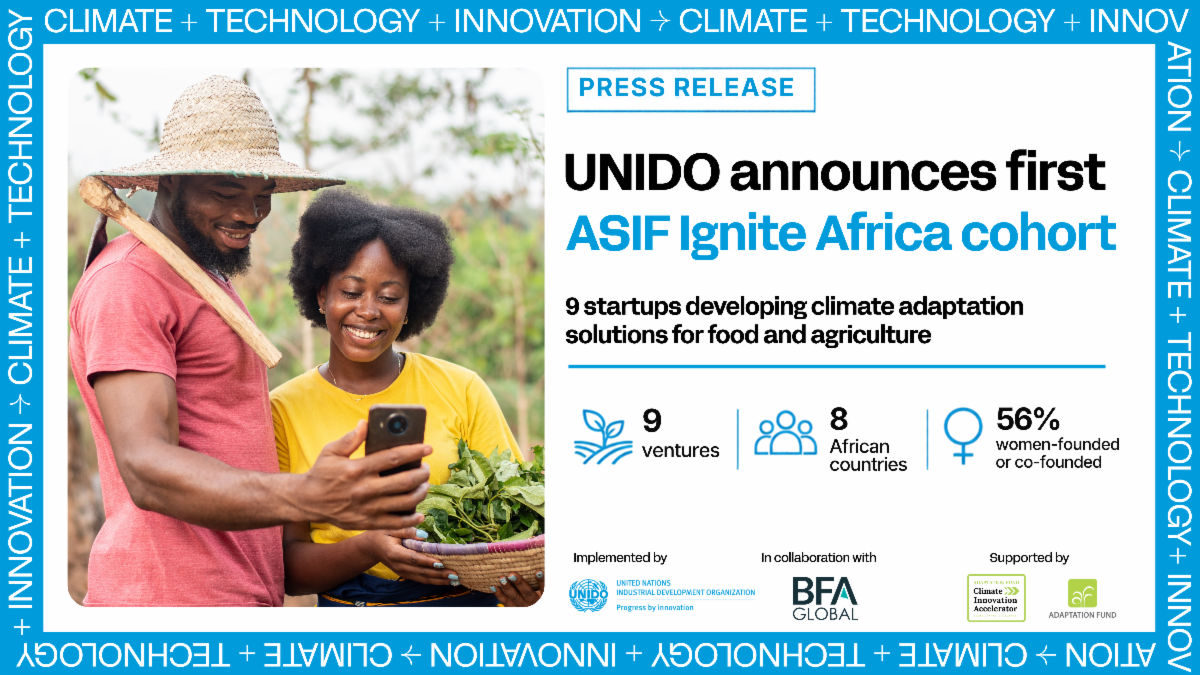
The United Nations Industrial Development Organization (UNIDO), in collaboration with BFA Global and funded by the Adaptation Fund’s Climate Innovation Accelerator (AFCIA), has selected nine climate adaptation start-ups from 453 applications for the first Africa Ignite cohort under the Adaptation Small and Medium-sized Enterprises Innovation Facility (ASIF).
The selected start-ups, drawn from eight African countries, are developing solutions to strengthen the resilience of food and agriculture value chains against climate change. They are early-stage enterprises operating at Technology Readiness Levels 3-4 and Business Readiness Levels 2-4, with solutions ready for further validation with intended users. Over the next eight weeks, the founders will test and refine their solutions through weekly live sessions, specialist office hours, hands-on AI training and real-world user testing.
The programme is designed to help them strengthen their business models, gather evidence of user demand and adaptation impact, and prepare for key commercial milestones including securing first customers, expanding their user base, attracting investment and scaling market-ready solutions. Ignite is led by BFA Global, with UNIDO leading ASIF’s ecosystem and learning component. Responding to climate pressure on food systems. Climate change is placing growing pressure on food and agriculture value chains across Africa, with smallholder farmers often the first and hardest hit by drought, erratic rainfall, flooding and other climate-related shocks.
The Ignite Africa start-ups are developing practical, locally tailored solutions for farmers, cooperatives, processors and agribusinesses to respond to these challenges and protect agricultural productivity, food security and rural livelihoods.“Climate adaptation is most effective when innovation is matched by proven impact.
Through ASIF Ignite Africa, UNIDO is empowering entrepreneurs to develop and strengthen climate adaptation solutions that build more resilient food and agriculture systems across Africa,” said Alois Mhlanga, Director of Climate Innovation and Montreal Protocol, UNIDO.“The remarkable diversity and quality of this first cohort demonstrate the ingenuity of African innovators and their ability to transform climate challenges into opportunities for sustainable growth and resilience.”Diverse cohort tackling risks across the value chainThe cohort brings together start-ups from Angola, Benin, Kenya, Malawi, Tanzania, Uganda, Zambia and Zimbabwe.55.6 per cent are founded or co-founded by women, while 77.8 per cent have a woman in a leadership position.
In five of the nine start-ups, founders described women as the majority of their current or intended users.Collectively, they address climate and agriculture advisory, water management and irrigation, food safety and traceability, agricultural finance, livestock feed, post-harvest processing, land-use risk assessment and waste-to-energy.Their work responds to drought, erratic rainfall, water scarcity, food safety risks, post-harvest losses, climate-related disruption to production and limited access to financing.“Every founder in this cohort has a working prototype.
The next step is often the hardest: putting it in front of a cassava farmer, a coffee cooperative or a poultry producer and learning what they will use and pay for,” said Rasima Swarup, ASIF Lead at BFA Global.“Our role is to make that step faster and less risky, with weekly sessions, specialists on hand, and candid feedback. We expect founders to leave Ignite clear on who they are building for, with sharper business models and the evidence partners and investors look for.”Alison Filler, Founder of Sapio Labs and a member of the ASIF Ignite Africa Selection Committee, said she was impressed by the diversity of solutions, from innovative material inputs and data infrastructure to new approaches to overcoming financing barriers.
Meet the CohortALLO VETO, Benin — Building ALLO NUTRI, a tool that formulates affordable, nutritionally balanced poultry feed from locally available ingredients when drought disrupts conventional supplies.Eco Biogas, Angola — Produces locally manufactured biodigesters that convert agricultural and organic waste into biogas and biofertilizer for small and medium-sized farms.
GeoVLUP Adaptation Services, Tanzania — Developing TerraClime Passport, which translates farm coordinates, climate stresses and land-use information into practical guidance for coffee farmers, cooperatives and buyers.Ghala Circular Solutions, Uganda Creating a regenerative capital basket through a circular savings model that unlocks gradual financing for inputs, equipment and climate-resilient technologies.
Global Vision Impact, Zimbabwe —Working on Resilience 40, a household-owned system that captures runoff, stores water underground and distributes it using solar power.Kilimora, Kenya Providing digital infrastructure for climate-resilient agriculture and pastoralist livelihoods through its AgriKonnekt platform, which combines satellite data, field observations and IoT for localised intelligence and weather updates.Linkbridge, Zambia Designing shared solar-powered irrigation infrastructure for clusters of smallholder farmers, with smart IoT and USSD controls for remote water management.
MTENGO wa Mizu, Malawi Building MT-TRACE, an offline-first digital traceability and food safety system for smallholder value chains, with HACCP-based checks and QR-code records for cooperatives and buyers.North Coast Innovators, Kenya — Supporting cassava farmers through farmer training, aggregation, solar drying and milling to reduce post-harvest losses and produce value-added food products.
What comes next The start-ups began their journey with an orientation session on 11 November 2026. Core programme activities will continue through November, pause in December, and resume in January 2027.
They are expected to present results of their user testing at the Founder Showcase and Feedback Forum in late February 2027.Applications are also open for ASIF Ignite Latin America and the Caribbean Cohort 1, focused on the water economy, with a deadline of 22 December 2026.