



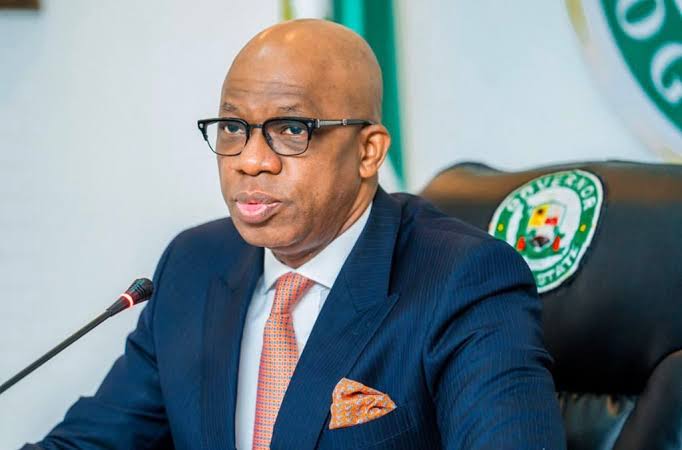
History remembers leaders not only by the offices they occupied, but by the generations they empowered. Across the world, the greatest political legacies are built around education. Leaders who understood that classrooms are the foundation of nations are remembered long after their political seasons end. In our own history, Chief Obafemi Awolowo’s free primary education revolution in the old Western Region remains proof of what is possible when a government decides that poverty should never determine a child’s access to knowledge.
Today, Ogun, popularly known as the Gateway State, is home to institutions like the Federal University of Agriculture, Abeokuta (FUNAAB), Tai Solarin University of Education (TASUED), the Federal College of Education, Abeokuta, and the Federal Polytechnic, Ilaro, and carries that same weight of expectation. Before this Scroll asks what remains undone, it must first record, honestly, what has been done.
What Does the Record Say?
Governor Dapo Abiodun’s administration came into office in 2019, inheriting a familiar Nigerian inheritance of ageing school infrastructure, overstretched classrooms, and a teaching workforce in need of urgent reinforcement. In response to this, his government introduced reforms aimed squarely at repositioning the sector, and the numbers behind those reforms are worth putting on the record:
Free education-The administration abolished all fees in public primary, secondary, and technical schools statewide, and cut the cost of a school transfer form from ₦20,000 to ₦5,000 removing a real financial barrier for families who had none to spare.
Classrooms rebuilt– Under the Ogun REHAB Initiative, ageing and dilapidated classrooms have been renovated across the state, with the government also assessing facilities in its 86 flagship secondary schools to guide further infrastructure investment.
Teachers recruited-Through the OgunTEACH programme, the administration has recruited thousands of new teachers into public schools one of the few direct responses to a shortage that has quietly weakened classrooms across Nigeria for a generation.
Merit-based scholarships- The Gbemiga Abiodun Education Support Programme an endowment launched in October 2023 in memory of the Governor’s late son supports learners in public primary and secondary schools, technical colleges, and tertiary institutions, including special needs learners, across Ikenne, Remo North, and Sagamu Local Government Areas. In its first three years it disbursed ₦252 million to 932 beneficiaries, growing from about 550 in 2023 to roughly 900 in 2025. The 2025 cohort also expanded to include 75 students from Ogun’s eight technical colleges, a 25 percent increase over the previous year.
Recognized excellence- One Ogun public school teacher, Solanke Taiwo, recently won a ₦50 million national teaching prize a signal, however small, that quality can still emerge from a public system under strain.
Ogun’s schools now educate a population that matters: the state carries a population of more than four million people, a large share of them school-age, with public and private schools together serving over one million learners across primary, secondary, and tertiary levels. These are not small undertakings. A roof that no longer leaks, a desk that did not exist last term, a newly employed teacher standing in front of a class that once had none each of these is a real change in a real child’s daily life, and it would be dishonest to pretend otherwise.
Education is the foundation of development and by that measure, this administration has, at minimum, understood the assignment: that a government which ignores its classrooms mortgages its own future. For this, credit is due. Not blind praise, not political loyalty simply the fairness that any honest record demands.
But a Building Is Not a Lesson
And yet, here the Scroll must turn.
Because access to a school is not the same as access to an education. A newly painted classroom can still hold a child who cannot read. A school with new furniture can still fail to produce a graduate ready for the economy waiting outside its gates. Infrastructure is visible it can be commissioned, photographed, and cut a ribbon for. Learning is invisible it can only be measured in the quiet, slow test of what a child actually knows.
This is the distinction Ogun State’s education story has not yet fully confronted: the difference between the quantity of infrastructure built and the quality of education delivered. A state can renovate a hundred classrooms and still fall short if its teachers are undertrained, its curriculum outdated, and its students taught to pass an exam rather than to think. A single well-resourced, well-taught classroom with a motivated teacher, a relevant curriculum, and a child who leaves able to reason, create, and compete is worth more to Ogun’s future than ten newly painted buildings sitting half-used. This is not a rejection of the infrastructure that has been built. Buildings matter; a child should not learn in the rain. But buildings are the floor, not the ceiling. The real measurement of any education policy was never going to be how many schools were rehabilitated.
Education financing also deserves careful attention. In its 2026 appropriation, Ogun State allocated a significant share of its budget to education a level many analysts would consider broadly consistent with international education financing benchmarks. However, global guidance promoted by UNESCO and its partners emphasizes not only the amount spent, but also how effectively those resources are invested, recommending that governments aim to allocate about 15–20 percent of public expenditure, or 4–6 percent of GDP, to education. For Ogun, as for many Nigerian states, the real challenge is not merely budgetary allocation but ensuring that every naira translates into better teaching, stronger curriculum delivery, continuous teacher development, adequate learning materials, and measurable improvements in learning outcomes. It is in these investments—the often unglamorous, unphotographable work of improving what a child actually knows—that the difference between adequate and exceptional education is made.
The Question Going Forward
Ogun State does not only need leaders who can count classrooms renovated. It needs leaders who can be measured by something harder to photograph: whether a child who passed through an Ogun public school can read confidently, reason independently, and compete anywhere in the world. That is the standard by which this administration and any that follows it should ultimately be judged. Not by how much was built, but by how much was learned.