



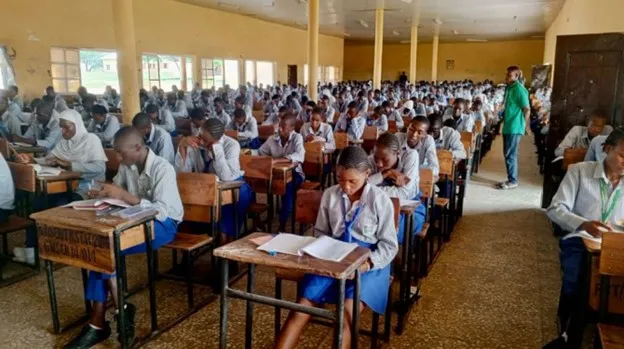
Ogun State’s public and private schools together number roughly 11,600 and serve just over one million learners, according to the most recent federal Annual School Census. The state ministry reports higher aggregated figures, including around 93,000 teachers and 86 flagship schools. That unspoken, unmeasured gap is the real story of education under Governor Dapo Abiodun not the one in the press releases.
Have you ever wondered what your child’s future would really look like if the only thing you changed was his location? Put one child in a well-resourced school in Abeokuta. Put another in a rural community school like Ohunbe Community High School, Yewa North. Give both the same intelligence, the same ambition and the same dream of becoming a doctor, engineer, lawyer, teacher or entrepreneur.
Then take away the labels and look at what each child is actually given. That is where the uncomfortable truth begins. You may discover that Ogun is not giving every child the same quality education. And if you are comfortable with that because your own child is on the better side of the divide, then this conversation is especially for you.
Walk with me through Ogun’s education system, not through a government brochure, but through a question you should ask yourself as a parent, teacher, taxpayer or citizen: what does a child actually receive for the seven or more years he spends in school?
In the urban centres, the names are familiar. Abeokuta Grammar School, Baptist Girls’ College in Idi-Aba, and other established schools around the state capital sit within an environment where pupils are closer to laboratories, libraries, private lessons, digital facilities and the wider academic ecosystem. The same is true of schools such as Iganmode Grammar School in Ota and Ijebu-Ode Grammar School in Ijebu-Ode. These are not all private schools, and that distinction matters: the point is not that every urban school is excellent, but that urban pupils generally operate closer to educational infrastructure and services. Ogun’s own 2025/26 screening data, for example, records 1,397 applicants and 774 successful candidates for Abeokuta Grammar School Junior, while Baptist Girls’ College Idi-Aba and Iganmode Grammar School are also among the schools in the state’s official system.
Now move away from those familiar urban names. Think about a child attending a school such as Community High School, Ojodu Abiodun, or Oke Odan Grammar School communities that appear in the state’s own education records and where the government has had to budget for additional classroom construction. In the state’s 2025 first-quarter budget performance report, planned three-classroom blocks at Community High School, Ojodu Abiodun and Oke Odan Grammar School were recorded at 0% performance for the quarter. The point is not to label those schools failures; it is to show you what the gap looks like when we stop speaking in abstractions and start naming actual classrooms and communities. And then there are Ogun’s riverine communities, where the problem becomes even more difficult because geography itself works against access. This is why the state’s January 2026 deployment of 448 OgunTEACH interns specifically to rural primary schools matters. The government itself acknowledged that rural schools needed additional manpower.
Now move away from the showcase.
Go towards the rural and riverine communities.
The question changes.
Who is teaching the child there? What is the pupil learning? Are these children really motivated to learn? What happens when the teacher is absent? What happens when the laboratory does not exist? What happens when there is no reliable electricity or digital access? And, most importantly, what happens to that child five years later after passing through all these gaps and is left to struggle?
You see, this is not really a debate about rural schools. It is a debate about your idea of fairness.
If a child in Abeokuta can grow up with access to technology, specialist teachers, laboratories, libraries, debate competitions and private tutoring, while another child in a hard-to-reach community struggles to get regular subject teachers, can we honestly call both children equally educated simply because both are enrolled in school?
I don’t think we can.
And neither should you.
Not how many schools have been commissioned, not how many applications have been launched, and certainly not how many speeches contain the words “education revolution.” The question is simpler and more uncomfortable: what are children actually learning?
Before you blame the child, look at the classroom. Recent research and official reports continue to highlight teacher-distribution problems in Ogun’s riverine and rural junior secondary schools, as well as ongoing challenges of funding, overcrowding, teaching materials and shortages of trained teachers in public secondary education. In 2026, after years of education reform, teacher deployment remains serious enough in parts of Ogun that the problem still requires attention. Teacher distribution and shortage continue to affect whether children in riverine communities can access quality junior secondary education.
Now imagine being that child. You sit for the same WAEC examination as the child in the city. You compete for the same university places. You enter the same labour market. But before the examination begins, you may have spent years with a weaker learning environment. Would you still call the final result a fair test of ability?
It is an argument about whether the state has put the conditions for learning where those children live. And the evidence is not confined to the riverine question. That should force a change in the way we talk about the rural–urban gap. The gap is not simply urban school versus village school. It is opportunity versus disadvantage.
A child who receives regular subject teaching, has access to books and technology, participates in debates and competitions, learns in a functioning laboratory and receives sustained academic guidance is accumulating advantages long before WAEC begins. Another child may be equally intelligent but is accumulating deficits. By the time both children enter the examination hall, we call the result “performance.” But the inequality began years earlier.
Now, let us talk about Dapo Abiodun’s policy. Let us be direct: the problem is not that the administration has no education policy. The problem is that after years of OgunLEARN, OgunTEACH, flagship schools and DiPER, the government has still not demonstrated with publicly disaggregated outcomes that its interventions are closing the rural–urban learning gap.
The administration has pushed OgunLEARN, OgunTEACH, flagship schools and DiPER. The state’s DiPER platform describes itself as a cloud-based system designed for real-time data analytics to improve teaching and learning outcomes.
In January 2026, the government deployed 448 OgunTEACH interns to rural public primary schools, explicitly because rural schools needed more teachers. But that announcement creates an uncomfortable question: if rural teacher shortages are serious enough in 2026 to require a special deployment of 448 interns, why has teacher distribution remained such a problem after years of education reform? The answer cannot simply be “we are recruiting teachers.” Recruitment is an input. A teacher standing in the classroom is the outcome that matters.
And the state has now built a system that should make this measurable. DiPER says it exists to provide real-time education data analytics. The Ministry says it has learner, teacher and school information at scale.
Then Ogun should publish the numbers that matter:
- Which schools have vacancies?
- Which subjects are affected?
- Which LGAs have the worst pupil-teacher ratios?
- Which schools have no functional laboratory?
- Which schools have no electricity?
- Which schools are consistently producing poor learning outcomes?
- Which rural pupils are progressing to tertiary education and which are dropping out before theyget there?
A government cannot claim data-driven education and then ask citizens to judge success from photographs of newly painted buildings.
Don’t confuse spending with reform. Ogun’s 2025 approved budget contains 49.66 billion for school infrastructure construction and rehabilitation, 3.72 billion for furnishing, 754.5 million for libraries and laboratories, and 629.7 million for education information-management systems. Those are significant commitments, but a budget line is not a learning outcome.
Ogun’s education spending is substantial, but even the government’s own documents tell us why allocation alone cannot settle this debate. The 2025–2027 Medium-Term Expenditure Framework places the education sector at 17% of the state’s sectorial allocation in each of those three years, with 177.835 billion in 2025, 216.752 billion in 2026 and 250.398 billion in 2027.
Those are serious numbers. But you and I should be careful here. A billion naira in a budget document cannot teach a child. A classroom cannot teach a child. A digital platform cannot teach a child. People teach children. Systems support them. Outcomes prove whether the investment worked. But here is the mistake government must avoid: assuming that a large allocation automatically equals a transformed classroom. It does not.
Money allocated is not money spent.
Money spent is not automatically money well spent.
And money well spent is not automatically improved learning.
The chain is simple: Allocation → implementation → classroom condition → teaching quality → learning outcome.
The public deserves evidence at every stage. That is why Ogun’s education conversation must graduate from budget announcements to outcome reporting. So what should you ask when you hear “education revolution”? Ask what changed for the child furthest from the centre of government somewhere in the interior of Ipokia, Yewa North, Odeda or Ikenne.
Ogun’s own education ministry reports higher aggregated figures (including around 93,000 teachers) alongside 86 flagship schools. It also says OgunTEACH is intended to address teacher shortages. Those numbers tell us the size of the system; they do not yet tell us whether quality is equal across it. Ogun has built an ambitious flagship-school model. The state currently lists 86 flagship schools. Don’t clap yet.
Flagship schools cannot become monuments to government branding. They must become evidence of improved learning.
- Where are the results?
- What is the baseline?
- What was the performance before intervention?
- What is it now?
- How many pupils are reading at the expected level?
- How many are passing core subjects?
- How many are entering higher education?
- How many are gaining the communication, digital and analytical skills demanded by the modern economy?
Until those numbers are published consistently, the flagship programme deserves neither condemnation nor celebration beyond the evidence. Build it. Measure it. Publish the result. Then let the public judge.
Here is the question I want you to ask government. If the state can track schools, learners and teachers digitally, why can it not publish a consistent 2017–2026 rural-versus-urban series showing teacher vacancies, pupil-teacher ratios, examination performance and progression to higher education? The absence of that public series makes it unnecessarily difficult for citizens to test the claim that the gap is closing. And that is precisely where the Abiodun administration should face pressure: not merely to spend, but to prove.
Here is where Ogun has a serious accountability problem.
You can find budgets.
We can find project announcements.
We can find numbers of classrooms.
We can find numbers of teachers recruited.
But a clean, publicly available 2017–2026 Ogun urban-versus-rural series showing WAEC performance, tertiary readiness and progression into higher institutions by school location is not readily available.
And this is where you, the reader, should become uncomfortable. If government can tell you how much it has budgeted, how many schools it has touched, how many teachers it has recruited and how many digital platforms it has launched, why shouldn’t it also tell you whether the child in a rural school is learning at the same level as the child in an urban school? That matters. Because if the government wants credit for closing the gap, it must be prepared to publish the baseline and the trend.
Otherwise, every administration can announce a programme, point at the expenditure and declare victory without answering the question of whether the child actually learned more. No baseline. No trend. No accountability.
If DiPER can provide school management, learner, teacher, classroom, examination and location data, then the government should stop asking citizens to infer equality from projects. Show us the rural schools that are improving. Show us the ones that are not. Show us whether teacher deployment is correcting the imbalance. Show us whether the child in a remote community is performing better than five years ago. That is what evidence-based reform looks like.
In January 2026, Ogun deployed 448 OgunTEACH interns specifically to rural primary schools to address teacher shortages. TESCOM was also undertaking teacher redistribution in public secondary schools to address urban–rural deployment imbalance. These are not reasons to celebrate the existence of the problem; they are evidence that the problem remains serious enough to require intervention in 2026. The harder question is why a government several years into its tenure is still responding to a basic distribution problem rather than demonstrating that it has permanently solved it.
This is where I want to move beyond criticism. If this were your child, would you accept another slogan? Would you accept another commissioning ceremony? Would you accept another app?
Or would you demand to know whether your child has a Mathematics teacher, whether the school has a laboratory, whether the child can read, whether the child can compete in WAEC and whether the child has a realistic route into higher education?
That is the standard government should face. The next government should not inherit another collection of slogans. It should inherit measurable obligations. Start with the data. Ogun should publish a school-by-school Rural Education Equity Index covering teacher vacancies, subject coverage, pupil-teacher ratios, classrooms, laboratories, libraries, electricity, water, sanitation, digital access, attendance, literacy, numeracy, examination performance and tertiary progression. If the state can collect the information, citizens should be able to see it.
Fund according to disadvantage. A school carrying the largest deficit cannot be treated as though it has the same needs as a school already functioning well. Equity is not giving every school the same cheque; it is directing greater intervention where the deficit is greatest.
Make teacher deployment permanent, not emergency. Ogun needs to recruit, house, incentivise and retain teachers in hard-to-reach communities. The 448 OgunTEACH interns sent to rural schools in January 2026 are evidence that the shortage is real; they should be the beginning of a retention strategy, not another short-term response to a problem that keeps returning.
Set a baseline, a target, and a deadline. Every major education intervention should have all three. And the state must follow children beyond secondary school. If rural pupils pass WAEC but cannot transition into higher education because of poverty, weak UTME performance or lack of information, the problem has simply moved downstream.
Make excellence travel. Debate programmes, reading initiatives, STEM clubs, digital learning, teacher exchanges and academic competitions should deliberately connect rural schools with Ogun’s strongest schools. A child should not need to live in Abeokuta before discovering that the world is larger than the road outside his village.
What would you call this? The rural child is not doomed. But the system can doom opportunity if we continue pretending that enrolment equals equality. The child is not the problem. The address is not the problem either. The problem is a system that can recognise disadvantage, budget against it and launch programmes around it, yet still has to prove that the child at the bottom of the system is learning on anything close to equal terms. The rural child is the test the test of whether Ogun’s education policy is genuinely about every child, or mainly about the children easiest to reach, easiest to photograph and easiest to showcase.
I have seen this disparity beyond Ogun. In 2019, through the African Child Education and Development Network, an organisation we founded around the idea of education with purpose, I participated in an African Rural Educational Outreach programme in Ghana’s Western Region, where we went into a rural community and installed a library. I did not see rural educational inequality from the pages of a report; I saw what the absence of learning resources can mean to children. That experience taught me something I have not forgotten: the rural child does not lack ambition. Too often, the rural child simply lacks opportunity. And that is why I believe government must stop treating passionate organisations working in education as people merely doing charity. There are NGOs, community organisations and individuals already willing to take education into places government structures sometimes struggle to reach. Government should partner with them, fund credible programmes, set measurable targets and monitor the outcomes. This is not charity. It is human-capital development, and it deserves the seriousness, funding and accountability of any other public investment.
And perhaps this is where Ogun needs to rethink what it believes education is supposed to accomplish. Education cannot remain an item in a budget that we remember whenever schools need renovation. It is the foundation upon which the state’s economic future is being built. Look at countries that understood this early. South Korea did not treat education as an isolated social service; it built human capital as part of a wider strategy for economic transformation. The lesson for Ogun is not to copy South Korea blindly. The lesson is to understand the principle: when a government deliberately invests in the knowledge, skills and capabilities of its people, it is investing directly in the productive capacity of its economy. So when Ogun leaves a rural child without a qualified Mathematics teacher today, it is not merely creating an education problem. It may be creating tomorrow’s skills shortage. When a child leaves school without strong literacy, numeracy, digital and analytical skills, Ogun loses part of the human capital it will need to compete. The question therefore is not simply, “Did government build the school?” The question is, “Did government build the child?” Because classrooms are infrastructure. Children are the investment.
Governor Abiodun deserves credit for putting money, programmes and technology into education. But after seven years in office, the standard must become higher than announcing interventions. The question is no longer whether Abiodun has done something. The question is whether what he has done has changed the odds for the child at the bottom of the system.
Because a government can build 86 flagship schools and still leave a rural child behind. It can deploy hundreds of teachers and still have schools with serious subject shortages. It can build a sophisticated digital platform and still fail to publish the numbers that would reveal where the system is weakest. It can spend billions and still leave citizens asking the most basic question: what changed for the learner? That is not an argument against investment. It is an argument for evidence. And Ogun should demand it.
Governor Dapo Abiodun has had enough time for citizens to move beyond promises and ask for evidence. The state can point to programmes, platforms, infrastructure and teacher interventions. Fine. But the question that should now follow every education announcement is simple: where is the measurable improvement in the life of the learner?
Not the photograph. Not the launch. Not the budget. Not the speech. The child.
Begins with the map. Map every school. Map every vacancy. Map every laboratory. Map every library. Map every electricity connection. Map every learning outcome. Then publish the map. Let Ogun see where its children are being served and where they are being short-changed.
Obafemi Awolowo’s educational legacy should not be reduced to political decoration. Its most difficult implication is that geography cannot become a verdict on a child’s future. So the question for the next government and for you as a citizen is brutally simple: if this were your child sitting in that rural classroom, would you accept the education he or she is receiving today?
If your answer is no, then you already understand the real meaning of the yawning gap. And if Ogun is serious about the future of its children, the next government must do more than promise to close it. It must publish the evidence that it has. It must measure the children it serves. And it must make it impossible for a child’s postcode to become a prediction of his future.
Seven years is long enough to announce a direction. The next phase must prove the destination. Because Ogun does not need two standards of education. It needs one standard and it must be good enough for the child government finds easiest to forget.