



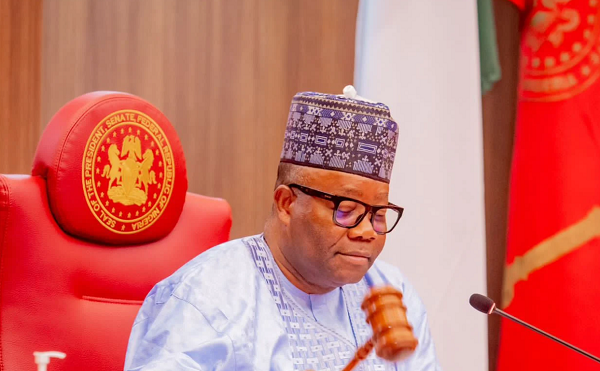
Senate President Godswill Akpabio has cautioned state governors against turning proposed state police structures into instruments of political intimidation, as the National Assembly intensifies efforts to establish state policing across the country.
Akpabio issued the warning on Tuesday during plenary, stressing that while the creation of state police could help address Nigeria’s worsening security challenges, adequate safeguards must be put in place to prevent abuse of power at the state level.
The Senate President’s remarks came as lawmakers began consideration of a Constitution Alteration Bill transmitted by President Bola Tinubu seeking the establishment of state police as part of broader security reforms.
According to Akpabio, concerns remain over the possibility that governors could use state-controlled police formations to target political opponents, suppress dissent, or influence local political processes.
He emphasized that while decentralizing policing may strengthen security responses and improve intelligence gathering at the grassroots level, accountability mechanisms would be essential to ensure professionalism and protect citizens’ rights.
The push for state police has gained momentum amid rising cases of banditry, kidnapping, terrorism, communal clashes, and other security threats across various parts of the country. Many security experts and stakeholders have long argued that a centrally controlled police system is overstretched and unable to effectively respond to local security challenges.
President Tinubu’s constitutional amendment proposal seeks to create a legal framework that would allow individual states to establish and manage their own police services alongside federal security agencies.
Supporters of the initiative argue that state police would improve response times, enhance local intelligence gathering, and enable communities to tackle insecurity more effectively.
However, critics have consistently warned that without strong oversight mechanisms, state police could become vulnerable to political interference and misuse by state governments.
Akpabio’s intervention highlights the growing debate surrounding the proposed reform, with lawmakers expected to examine issues relating to operational control, funding, recruitment, accountability, and constitutional safeguards before any final approval.
If passed, the establishment of state police would represent one of the most significant changes to Nigeria’s security architecture since the return to democratic rule in 1999.